
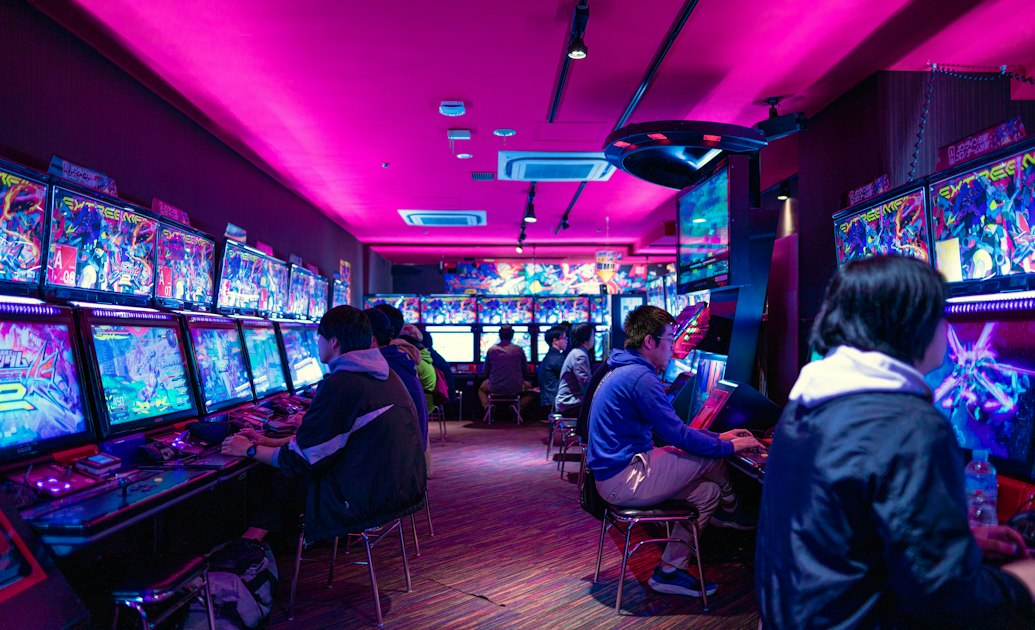
Before the millions of followers, the professional gamers, the streaming contracts, and the fancy gaming setups, there were quarters, joysticks, and a generation of kids who fell in love with video games.
And some of us never fell out of love.
It All Started With Mom
Some of our earliest memories of video games didn’t involve playing them.
They involved our mother.
Back in the 1980s, there was a neighborhood convenience store called Swanny Swifty. Like many convenience stores of that era, it had something that could turn a quick stop into an extended visit: an arcade machine.
And our mother loved Ms. Pac-Man.
She’d come home after spending hours playing that game, and we couldn’t quite understand the fascination.
Until we watched her play.
Man, was she good!
She’d glide through those mazes, turn corners like she knew something the ghosts didn’t, and make absolute ass-clowns out of Blinky, Pinky, Inky, and Clyde.
Especially that damn red ghost!
Watching her play was mesmerizing. The timing, the precision, the confidence. She made it look effortless.
Then we finally got our hands on the joystick.
CHOMP!
Dead.
Another quarter.
CHOMP!
Dead again.
Suddenly, we understood something important.
Mom wasn’t just playing Ms. Pac-Man.
Mom had skills!
And without knowing it, she had introduced us to something that would remain part of our lives for decades.
The Arcade Era: Where Legends Were Born
<text></text>
If you grew up in the late 1970s or 1980s, you remember the sights and sounds.
The hypnotic simplicity of Pong.
The unmistakable waka-waka-waka of Pac-Man.
The electronic explosions of Space Invaders.
The glow of arcade cabinets lined against the walls, the clicking of buttons, the movement of joysticks, and the glorious sound of quarters dropping into machines.
Arcades were more than places to play games.
They were gathering places. Battlegrounds. Social clubs.
And occasionally, classrooms where some kid half your age would teach you a lesson in humility.
We didn’t have online leaderboards. We had three initials beside a high score.
And if your initials were at the top?
You were somebody!
At least until the next kid came along.
Atari: The Neighborhood Invasion
Eventually, gaming started making its way into our homes.
Well, somebody’s home.
Not necessarily ours.
We had a neighborhood friend who owned an Atari, and we invaded that poor kid’s house like it was a military operation.
We’d show up ready to play and somehow spend more time on his Atari than he did.
Looking back, the boy deserved rent money.
But the idea was revolutionary.
We could play video games at home!
No quarters. No closing time. No standing around waiting for someone to finish.
Of course, there was still one obstacle.
Our friend’s parents eventually wanted their house back.
Then something wonderful happened.
Nintendo: Now We’re Playing With Power!
Our mother managed to get us our very first gaming system.
The Nintendo Entertainment System.
The NES!
If you were there, you remember how exciting that was.
We weren’t simply getting another toy.
We were getting an entirely new world.
And one little plumber was about to take over our lives.
Super Mario Bros.
We ran. We jumped. We fell into holes. We got flattened, burned, and knocked off platforms.
We lost life after life.
But we kept coming back.
Eventually, through determination, practice, and an unreasonable amount of free time, we beat the game.
We had conquered the Mushroom Kingdom!
We thought we were the shit.
And then our cousin came over.
There Are Levels to This Shit!
You ever watch somebody do something you thought you were good at, only to realize you were barely scratching the surface?
That was us watching our cousin play Super Mario Bros.
We’d been carefully navigating levels, avoiding enemies, and approaching obstacles with all the caution of somebody carrying a full glass of water across a freshly mopped floor.
Not this dude.
He pressed that A button like it owed him money.
Full speed!
He’d slide under obstacles, bounce off Paratroopas, use Bullet Bills as stepping stones, and fly through sections we’d spent hours trying to survive.
Then he showed us the famous infinite-lives trick in World 3.
Our jaws practically hit the floor.
WAIT A DAMN MINUTE! YOU CAN DO THAT?!
We had beaten Super Mario Bros.
But our cousin had mastered Super Mario Bros.
That day, we learned a lesson that would follow us through generations of gaming:
There’s beating a game. And then there’s being GOOD at a game.
We wanted to be good.
Really good.
And from that moment, the mission changed.
The Golden Age of Getting Our Ass Kicked
We devoted a considerable portion of our childhood to mastering video games.
We took on Mike Tyson’s Punch-Out!!
We explored the kingdom of Hyrule in The Legend of Zelda.
We battled through Ninja Gaiden, a game seemingly designed by somebody who hated children.
And we won.
Not always quickly. Not always gracefully.
But we won.
Of course, there were exceptions.
Battletoads?
That damn Turbo Tunnel!
Teenage Mutant Ninja Turtles on the NES?
If you know, you know.
Some games humbled us so thoroughly that we still remember the frustration decades later.
But that’s what made gaming special.
There were no participation trophies.
The game didn’t care how frustrated you were. It didn’t care how many times you had failed.
You learned. You adapted. You tried again.
And sometimes you turned the console off, went outside, and pretended you weren’t furious.
From Pixels to Entire Worlds
While we were growing up, gaming technology was growing up with us.
The Atari 2600 introduced many of us to home gaming, but the NES helped make it a household obsession.
Then came the Sega Genesis and Super Nintendo.
Sixteen-bit graphics. Richer colors. Better sound. Faster gameplay.
Suddenly, our living rooms were delivering experiences that would have seemed impossible just a few years earlier.
We watched Sonic race across our television screens.
We fought our friends in Street Fighter II and Mortal Kombat.
We discovered bigger adventures, deeper stories, and increasingly sophisticated worlds.
Then came the leap into three dimensions.
The original PlayStation, Nintendo 64, and later generations of consoles transformed what games could look and feel like.
Characters became more expressive. Worlds became larger. Stories became more cinematic.
And over time, home consoles surpassed many traditional arcade machines in overall gaming capability, convenience, and eventually visual sophistication.
The arcade had once been the place where we went to experience the future.
Now the future was sitting beneath our televisions.
And we didn’t need a pocketful of quarters to enjoy it.
Then online gaming changed everything again.
Our competition was no longer limited to the kid down the street.
We could challenge somebody on the other side of the country—or the other side of the planet.
And the games kept evolving.
From a bouncing square in Pong to the sprawling open worlds of Grand Theft Auto.
From a yellow circle eating dots to the colorful, competitive chaos of Fortnite.
From pixelated wrestlers to the elaborate entrances, arenas, and superstar rosters of WWE 2K.
We witnessed an extraordinary transformation.
And we were there for every generation of it.
Remember When Being a Gamer Wasn’t Cool?
Here’s something younger gamers might find difficult to believe.
There was a time when playing video games wasn’t exactly considered fashionable.
We were nerds.
Geeks.
The kids who spent too much time staring at television screens.
The jocks had their sports.
The popular kids had their parties.
And the girls we were trying to impress?
Well, let’s just say telling them about our latest high score wasn’t always the winning strategy.
Meanwhile, our parents had a familiar announcement:
“TAKE YOUR ASS OUTSIDE AND PLAY!”
And you know what?
That was pretty good advice!
We needed sunshine, exercise, friendships, and experiences beyond the television screen.
Still do.
But nobody could have predicted just how dramatically the world would change.
Wait… People Are Getting PAID to Do This?!
Fast-forward a few decades.
Gaming isn’t just popular.
It’s a cultural phenomenon.
Professional competitors fill arenas. Gaming personalities attract enormous audiences. Content creators build businesses around something we once did simply because we loved it.
And some of them earn millions.
MILLIONS!
Playing video games!
Excuse us?!
We spent our childhoods getting yelled at for playing too much, and now people are making fortunes doing the same thing?
Somewhere, there’s an entire generation looking at this situation and thinking:
WE WERE BORN TOO EARLY!
But consider what happened.
Creators like Ninja, Tfue, Myth, Daequan, Pokimane, DrLupo, TimTheTatman, and many others helped introduce livestream gaming to massive audiences.
Before and alongside them, pioneers such as PewDiePie, Markiplier, and early gaming broadcasters helped demonstrate that people didn’t just enjoy playing video games.
They enjoyed watching other people play them.
And the personalities became part of the entertainment.
The reactions. The competition. The comedy. The community.
Today, gamers from every walk of life are building audiences.
Yes, even those beautiful young women rocking cat-eared headphones and absolutely destroying the competition.
Times have changed!
The hobby that once got us labeled geeks is now mainstream entertainment.
And the kids who grew up playing video games?
Some of them became the people who built the industry.
Others became the parents who introduced their own children to gaming.
And some of us?
Well…
We’re just getting started.
We Didn’t Miss the Gaming Revolution. We Helped Start It.
Here’s the thing.
We aren’t outsiders trying to understand a younger generation’s hobby.
We helped establish the culture that made it possible.
Not individually, of course. But collectively, as the kids who kept playing, kept buying games, kept sharing discoveries, and kept pushing the industry forward.
We were there when gaming meant a joystick and one button.
We were there when saving your progress was a luxury.
We were there when beating a game required patience, persistence, and sometimes an almost supernatural tolerance for frustration.
We watched the technology evolve.
We watched the culture evolve.
And now we’re watching gaming bring generations together in ways we never imagined.
Pong helped pave the way for Pac-Man.
Pac-Man helped pave the way for Mario.
Mario helped pave the way for the extraordinary worlds we explore today.
And that generation of arcade kids?
We’re still here.
Still holding controllers.
Still learning new games.
Still talking trash.
Still celebrating victories like we just won a world championship.
And occasionally, still getting our asses handed to us by somebody half our age.
Some things never change.
The Return of the Arcade Generation
That’s why Unc Arcade exists.
Not because we’re trying to turn back the clock.
And certainly not because we think the old days were better in every way.
We’re here because we love where gaming came from, we love what it’s become, and we can’t wait to see where it goes next.
We want to share the nostalgia with those who remember.
We want to experience the excitement with those discovering gaming today.
And we want to prove that a love for video games doesn’t come with an expiration date.
We might not have the reflexes we had at sixteen.
But we’ve got decades of experience, a lifetime of stories, and enough trash talk to keep things interesting.
So to the younger generation:
We see you.
We appreciate what you’ve brought to gaming.
And we look forward to competing with you.
Just remember one thing.
Before you were dropping into Fortnite, we were dropping quarters into Pac-Man.
And now?
WE’RE BACK!
Pull up a chair. Grab a controller. Bring your best game.
Because the arcade generation has returned.
And we’re not here just to reminisce.
We’re here to play.
UNC ARCADE — WHERE GENERATIONS COLLIDE.
Leave a Reply